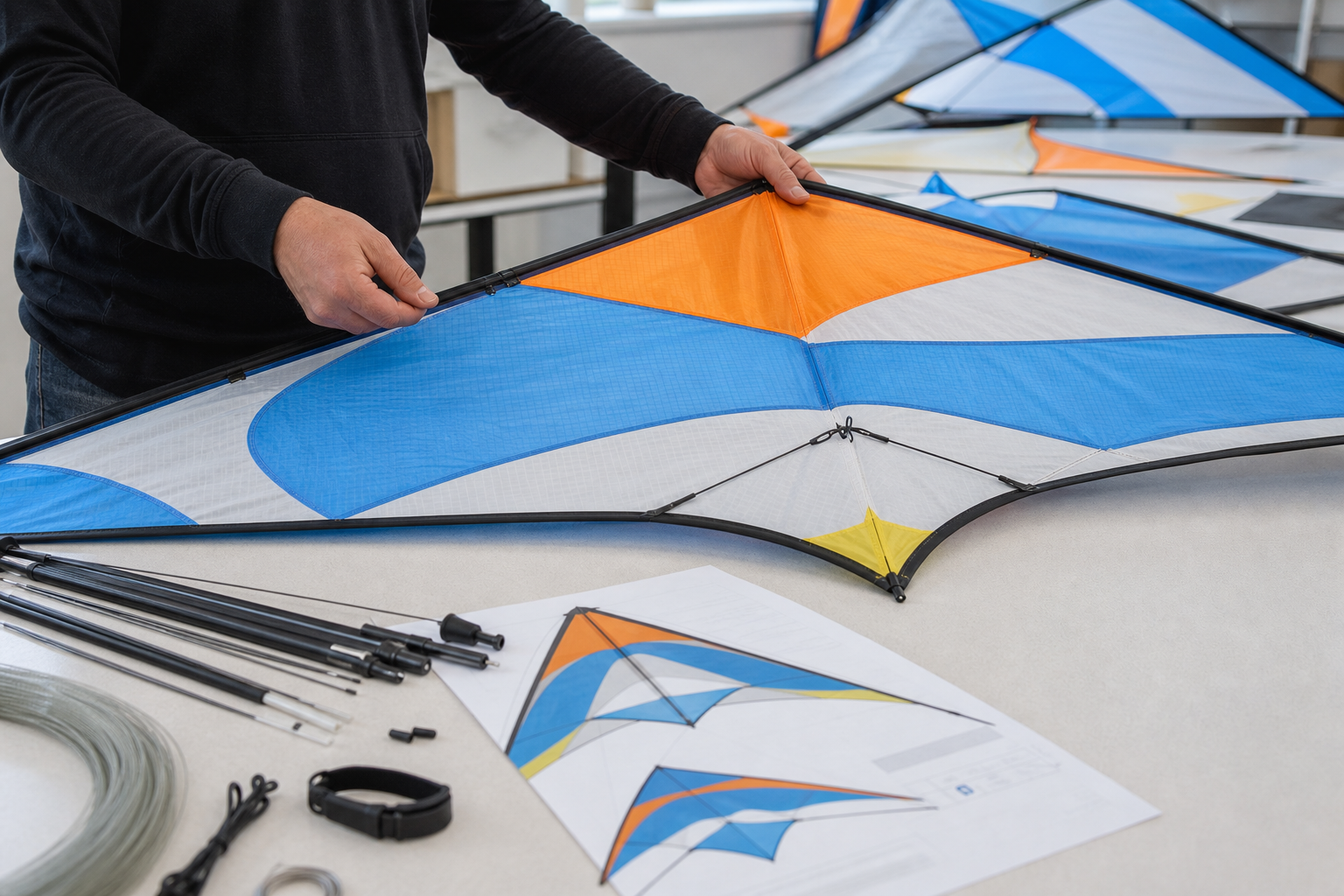
Ordering custom kites is not simply a matter of sending a logo and choosing a quantity. The best result comes from matching the kite type, materials, print method, packaging and testing standard to the way the product will actually be used. A clear sourcing plan also helps buyers compare quotations accurately and avoid costly revisions after production begins.
This guide explains the main decisions in custom kite manufacturing, from MOQ and artwork preparation to sampling, lead times and quality control. It is written for importers, promotional agencies, toy distributors, event suppliers, schools and retailers planning a repeatable custom or wholesale kite program.
Custom kite manufacturing at a glance
- Start with the target user, flying environment and commercial objective?not the artwork alone.
- Select a stable kite format before finalizing dimensions, frame materials and print coverage.
- Treat MOQ as one pricing variable; print method, packaging and component specification can matter just as much.
- Approve a physical sample or clearly defined pre-production sample before mass production.
- Confirm inspection criteria, packing method and shipping marks in writing.
1. Define the use case before choosing a kite
A custom kite for a beach retailer has different priorities from a branded giveaway for a one-day campaign. Retail products need shelf appeal, consistent performance and practical packaging. Promotional products may prioritize print visibility, campaign colors and an efficient distribution format. School kits need simple assembly, clear instructions and age-appropriate components, while festival kites may require larger visual impact and more experienced handling.
Before requesting a quotation, define the expected user age, flying location, required skill level, desired retail or giveaway price, target delivery date and destination country. These details allow a manufacturer to recommend a realistic construction instead of quoting an attractive but unsuitable specification.
2. Select the right kite type
The kite shape influences stability, visual area, assembly and user experience. Common options include:
- Delta kites: a versatile single-line format with a broad printable sail. They are often considered for branded events, gifts and general outdoor use. See our delta kite options.
- Diamond kites: a familiar silhouette with strong visual recognition. They can suit children’s ranges, seasonal promotions and simple retail assortments.
- Dual-line stunt kites: designed for more active control. They require clearer performance specifications and are better matched to users who want a sport-oriented experience.
- DIY kite kits: supplied for assembly and learning activities. Component organization, instructions and packaging are central to the product experience.
- Festival and specialty kites: chosen for visual scale or a distinctive shape. Confirm wind range, assembly requirements and the experience level expected from the operator.
A reliable supplier should be able to explain the trade-offs between formats rather than recommending one model for every project. Browse the kite product range to compare common categories before preparing your RFQ.
3. Choose sail, frame and flying components
Material decisions affect print appearance, weight, durability, cost and packing size. Kite sails commonly use lightweight synthetic fabrics or film-based materials, depending on the format and price point. The specification should identify the material type and, when relevant, its weight or thickness rather than relying on vague descriptions such as ?premium fabric.?
Frames may use fiberglass, carbon-based components or other suitable rods. Fiberglass is often selected for practical, cost-conscious programs because it offers useful flexibility. Higher-performance designs may call for a lighter or stiffer structure. The correct choice depends on the kite’s size, target wind conditions, performance expectations and budget.
Do not overlook flying line, handles, winders, connectors, tails and small fittings. Ask whether the quoted product includes every component required for use and whether replacement or accessory supply is available. For complete assortments, review our kite accessories and flying lines.
4. Match the printing method to the artwork
Printing is one of the largest variables in a custom kite quotation. A simple one-color logo and a full-sail photographic design should not be priced or produced in the same way. Depending on the sail material, artwork and quantity, a project may use screen printing, digital transfer, sublimation or another suitable process. The manufacturer should recommend the method after reviewing the actual artwork.
- Provide vector artwork when possible, with fonts converted to outlines and linked images embedded.
- Specify Pantone, CMYK or other approved color references instead of judging color only from a screen.
- Mark the required print area and orientation on a dieline or product template.
- Identify any small text, fine lines, gradients or edge-to-edge coverage that may affect print feasibility.
- Approve a digital layout, but remember that a screen proof cannot fully replace a physical color and construction sample.
Custom kite sourcing principle
5. Understand MOQ and the real cost drivers
MOQ?the minimum order quantity?is influenced by the base kite, material availability, print setup, packaging and production scheduling. A lower MOQ can be possible for a standard model with limited customization, while a fully bespoke shape or individually designed package may require a larger production run.
Compare quotations on a like-for-like basis. Confirm whether the price includes printing setup, sample charges, individual packaging, instructions, labels, export cartons and inspection. Also ask whether the quoted unit price is EXW, FOB or based on another Incoterm. A low unit price can become misleading if essential components or services are excluded.
6. Use a controlled sample and approval process
Sampling is the bridge between a quotation and mass production. The process may begin with an existing sample to confirm the general model, followed by an artwork layout and a customized pre-production sample. For repeat orders, an approved sample can serve as a reference together with the written specification.
- Confirm dimensions, shape and included components.
- Approve the artwork placement, orientation and color references.
- Review stitching, reinforcement, frame fit and assembly.
- Check packaging, instructions, labels and barcode placement.
- Record every approved change in the final purchase specification.
7. Plan lead time from approval?not only from payment
Production lead time normally depends on when the final artwork, sample, specification and packaging are approved. Seasonal demand, custom material procurement and inspection can also affect the schedule. Shipping time is separate from manufacturing time and varies by route and transport method.
For a fixed event date, work backward from the required arrival date. Include time for customs clearance, inland delivery and a reasonable contingency. Tell the manufacturer the date the goods must arrive?not merely the date you hope production will finish.
8. Build a practical quality-control checklist
Quality control should be based on measurable requirements. The exact inspection plan depends on the product and market, but a custom kite checklist can cover:
- Finished size, sail shape and component count.
- Material, rod specification, line and handle type.
- Print position, orientation, color tolerance and visible defects.
- Stitching, hems, pockets, reinforcement and secure attachment points.
- Assembly fit and basic functional checks appropriate to the kite design.
- Packaging contents, warning labels, instructions, barcodes and carton marks.
- Quantity, assortment ratio, carton dimensions and gross weight.
If your destination market requires specific testing, labeling or documentation, state those requirements before quotation. The importer is responsible for confirming which regulations apply to the product, user group and country of sale.
9. Specify packaging and shipping details
Packaging protects the kite, communicates the product and affects freight efficiency. Options can range from simple polybags and fabric sleeves to printed retail cartons or custom sets. Confirm whether instructions, header cards, labels, barcodes, hang holes and master-carton marks are required.
Ask for estimated packing quantity, carton dimensions, net weight and gross weight before finalizing the shipping plan. A compact folded design may reduce freight volume, but it must still be easy for the end user to assemble without damaging rods or fittings.
10. Evaluate a custom kite manufacturer
A capable custom kite manufacturer should ask questions before giving a final recommendation. Clear communication about application, artwork, materials, timeline and compliance is a positive sign. When comparing suppliers, consider response quality, specification detail, sample accuracy, change control, inspection support and consistency?not only the lowest unit price.
It is also useful to ask how repeat orders are controlled. Confirm whether the supplier records approved artwork, color references, packaging files and bill-of-material details. Repeatability is especially important for distributors and promotional agencies serving recurring campaigns. Learn more about our custom kite development process.
Information to include in your custom kite RFQ
- Target market and intended use.
- Preferred kite type, size and approximate quantity.
- Artwork file, number of designs and required print coverage.
- Material or performance preferences, if already defined.
- Packaging, labeling, barcode and instruction requirements.
- Required destination, Incoterm and arrival date.
- Applicable testing, documentation or market-specific requirements.
Frequently asked questions
What is the MOQ for custom printed kites?
MOQ varies with the kite model, material, number of designs, print process and packaging. A standard model with a straightforward logo may support a different MOQ from a fully bespoke sail shape or retail box. Share the full specification to receive a meaningful quantity recommendation.
Can I order a sample before mass production?
Yes. Depending on the project stage, the sample may be an existing product sample, a print proof or a fully customized pre-production sample. Confirm what the sample will demonstrate and which details still require approval.
Which file format is best for kite printing?
Editable vector artwork is usually the most flexible for logos, line art and precise placement. Convert fonts to outlines, embed linked assets and include color references. High-resolution raster files may be suitable for photographic designs when they meet the required size and resolution.
How long does custom kite production take?
Lead time depends on quantity, customization, material availability, sampling, production workload and inspection requirements. Request separate estimates for sample preparation, mass production and shipping, and allow contingency for fixed campaign dates.
What should I compare in two supplier quotations?
Compare the complete specification: size, material, frame, line, printing, accessories, packaging, sample policy, inspection, Incoterm and production schedule. Unit prices are only comparable when the included product and service are equivalent.
Plan your custom kite project
A successful order begins with a clear brief. Send us your application, quantity, preferred style, artwork and delivery destination. We can review the requirements and help you organize the next steps for sampling and quotation.